An update
Since I wrote this article, the St Clement solar array has come on stream and I understand it is performing well. There has also been remarkably little comment about it since commissioning, which suggests that the visual impact is not causing much upset.
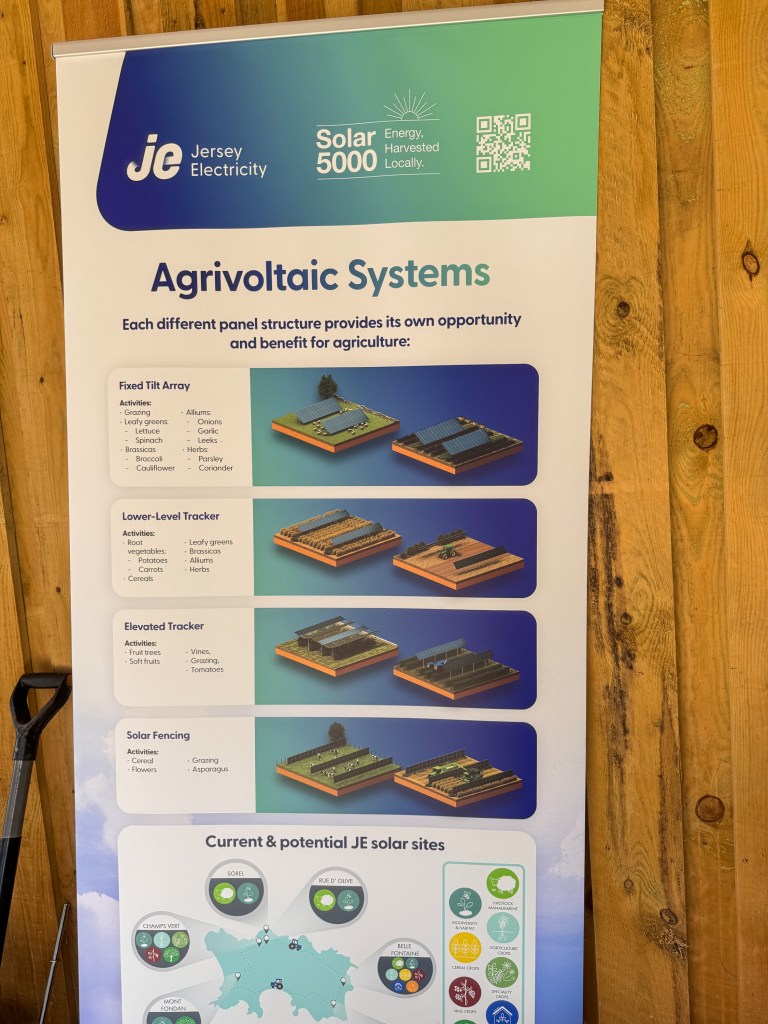
There are now several other schemes being planned, including a particularly innovative one in St Martin that has the potential to be a pioneering example of “agrivoltaics” – where solar installations are combined with a range of farming activities. It is often said in opposition to ground based solar that we shouldn’t take away agricultural land. But that argument evaporates when the two uses are combined.
(As a side comment, in this context, it was slightly bemusing to hear people try and argue on social media – in relation to the St Clement scheme – that having sheep on the land wasn’t really farming. Try this thought experiment. Imagine a field full of sheep. Is this sheep farming? I think we can all agree a field with sheep is being used for farming. Now imagine the same field with the same sheep and the addition of solar panels. Clearly, the field hasn’t gone out of farming use, rather it now has two uses.)
What’s exciting about the St Martin scheme is that the agricultural part of the scheme has been developed significantly. They are looking at fruit trees, vines, root crops and so on. Plus, the nature and density of the solar installation can be varied; for example, vertical solar panels (facing E-W) can be better combined with some crops, whilst extending generation to the beginning and end of the day.
There’s one other point that is raised which is about whether solar panels are needed, given the French interconnectors. The point is that our French interconnectors actually make Jersey an ideal site for ground based solar. At a single stroke, the problem of intermittency is solved. But with the advantage that island generated solar electricity gives JE a “wedge” of power at a guaranteed price, stretching 40 years into the future. That is a vital hedge against potential energy shocks in the future. (It is a common misunderstanding to think that JE’s contract with EDF guarantees the price of all the electricity it buys. In fact, only a relatively small chunk is at a fixed price, the rest is bought throughout the length of the contract at different strike prices.)
So for me, agrivoltaics is a win-win. It gives a new form of income to farming and it provides secure, on island generation at a fixed price.
Original post
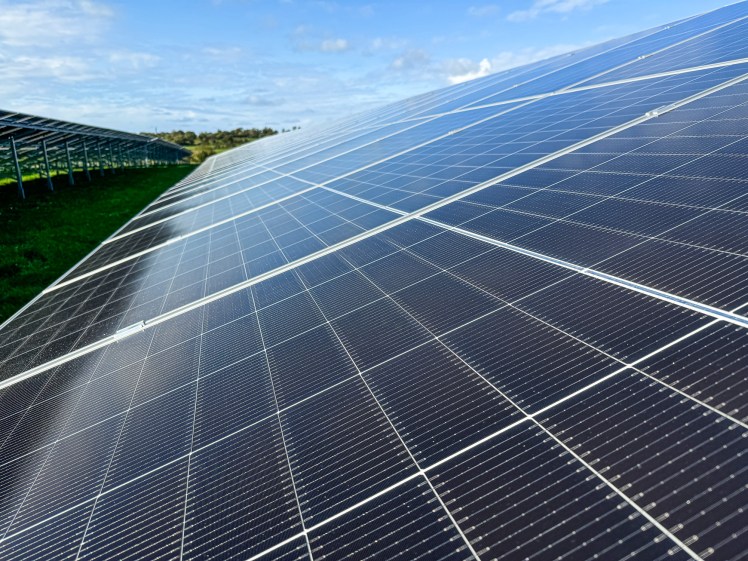
In a corner of St Clement near the Grouville border, hidden away down a narrow lane, a fascinating renewable energy project is taking shape: Jersey’s first large-scale, ground-mounted solar array. On completion – hopefully by the end of the year – the Jersey Electricity array will produce over 4MW of electricity a year, enough to power around 14% of the homes in St Clement. But that’s not the only potential benefit to come from the development.
- Panigot Farm are going to be grazing a significant flock of sheep around and under the panels, year round, expanding their production of meat for the local market.
- A variety of grass and clover seeds have been planted to enhance the grazing and improve biodiversity potential. Soil quality will also improve (particularly for example soil carbon), such that if a decision is taken in the future to return the fields to more traditional farming, there will have been a net improvement.
- Around the fields, new hedges are being planted, and because there is no need to maximise crop yield, these hedges can be wider (like in the good old days); a significant gain for biodiversity.
- The primary contractor is from the UK, but they have subcontracted work to local companies like Geomarine, and they have put effort into upskilling the local workforce so that future solar installations can benefit from a stronger skills base on island. Altogether, something like 14 local companies have been involved in the solar farm project.
I know there has been some opposition to ground based solar arrays on farmland, but I hope that as the project develops, some of the fears will dissipate. It’s worth remembering that the solar structures are all removable, so the land can be returned to arable farming very quickly. In the case of the St Clement site, it is really well hidden, so its visible impact is small.
In terms of the bigger picture, we do not need as much farmland for potatoes and dairy as we used to, so finding new, innovative uses for (currently) redundant fields is a debate we need to have – and in this case, farming (livestock) can be combined with the solar array.
It’s often said we should use rooftop solar before we use fields, but there are a couple of counter arguments to that. First, ground mounted solar is more efficient and cheaper. Panels can be perfectly orientated, and because the installation is large, the unit costs fall. Second, the two are not mutually exclusive – Jersey should pursue (and is pursuing) rooftop solar and ground based arrays. There’s room for both.
No one is suggesting Jersey should be carpeted in solar panels. We will need to look closely at each site, and also at the cumulative effect of multiple applications for ground based solar. But with the right locations in terms of unused farmland and low visual impact offer an opportunity to diversity our electricity supply and – with careful management – improve the environment, whilst maintaining a farming use.

