(Note: A summary of the key policy pledges in this manifesto can be found here.)

It has been a huge honour – and a pleasure – to represent St Brelade in the States Assembly these last four years, so first of all I would like to thank those of you who put your faith in me four years ago. I hope you can see that I have put my heart and soul into trying to improve the parish and the island – both as an effective minister and as a very active backbencher.
Now I’m asking for your support again. I’ve learnt a lot in my first term and I’d like to think that means I can be an even more effective member of the Assembly, if elected for a second term.
Values
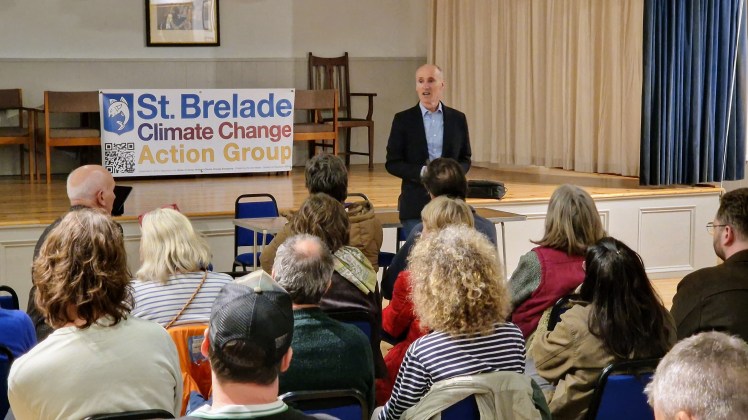
My core values are at the root of everything I do in politics.
Transparency and honesty — because that is the foundation of trust between government and the people it serves
Fairness — because everyone should have the freedom to flourish
Protecting the environment — because it is our greatest inheritance, the foundation of our wellbeing and the basis of so many economic opportunities
Working together — because effective politics means consulting properly, valuing alternative views and finding sensible compromises
Finding Hope

After four years as your representative, one thing is obvious: there’s a lot of frustration, anger and cynicism about the state of Jersey — and the state of our politics. People feel the system isn’t working for them. That government hinders rather than helps. That decisions are taken elsewhere by people who aren’t listening.
And yet alongside that frustration, there’s something else entirely: a huge desire for government to actually use its power to improve people’s lives. Phenomenal community energy. Real pride in what makes St Brelade – and Jersey – so special. And a genuine hunger to get involved, to do something.
That’s why I find being a parish deputy so special. It combines the ability to make a real difference at a local level with access to the wider levers of power — the best of both worlds. What’s more, I am absolutely convinced that the best days for our parish and for our island still lie ahead of us. Otherwise I wouldn’t be standing. That’s why I have pride in our parish and hope for our island.
Over the last four years I’ve made progress (and I’ve set out what I think I’ve achieved elsewhere). But I know there’s a whole lot more to do.
The big picture
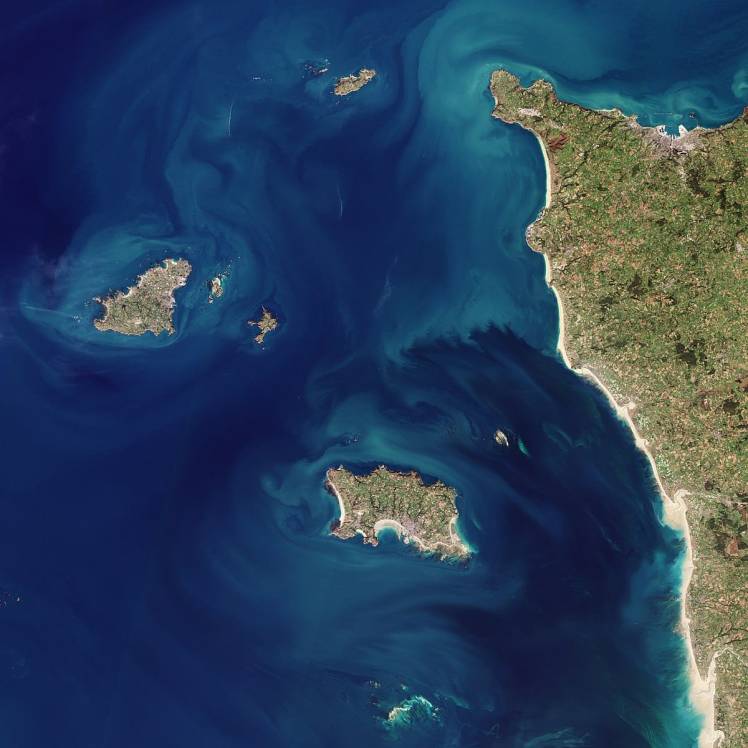
We enter this election at a time of global crisis and instability, so it is especially important to consider Jersey’s place in the bigger picture.
- Turmoil is everywhere: wars in the Middle East, old alliances collapsing, the rise of political extremes – there is no question we live in exceptionally dangerous and unstable times.
- All over the world, price shocks are delivering hard blows to people struggling to do the best for their families.
- Economic growth is hard to come by and the desperate search for growth at any costs is threatening hard won environmental gains and vital social protections.
- Every advanced economy is dealing with challenges such as an ageing population, rapidly rising health costs, the rise of AI, and increasing poverty and inequality.
- Meanwhile, the existential threats posed by climate change and destruction the natural world continue, even as other agendas undermine action in these vital areas.
- These are colossal tectonic shifts, which pose huge challenges for all of us. But they also create opportunities. This election is our chance to take control of our destiny, to hammer out a new consensus for a way forward.
A Safe Harbour
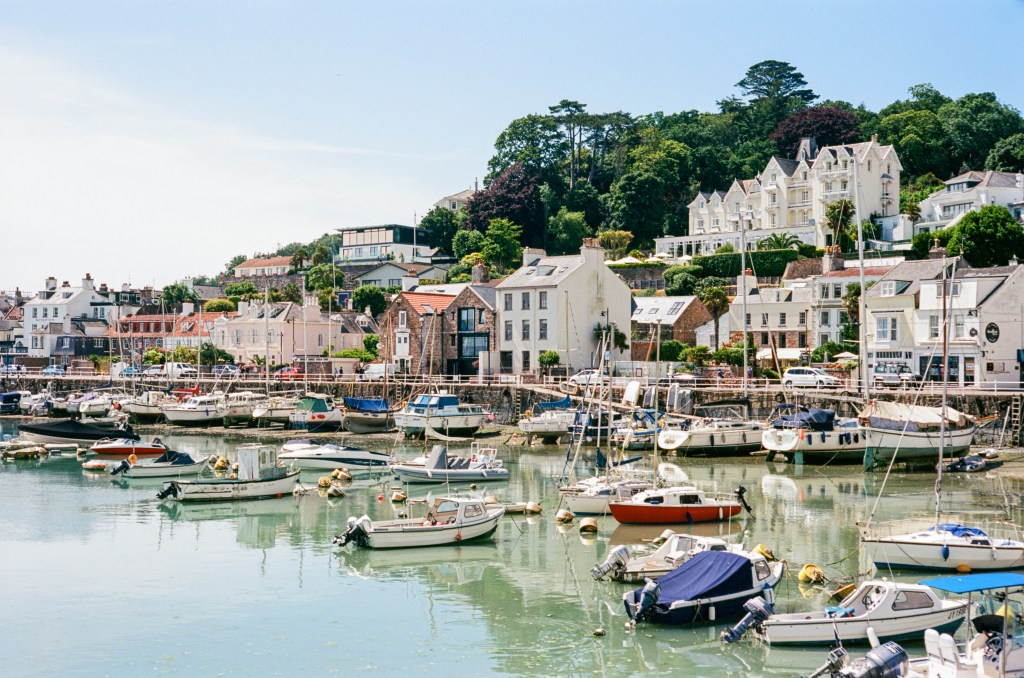
Grim as the situation is, all is not lost. When the seas are rough, sailors look for a safe harbour. Jersey can be that safe harbour; for businesses seeking stability, and for people who want to live in a place of safety, governed with sensible, rational decision making.
That is our mission… and an opportunity: to be a safe harbour in the midst of chaos. A place that stays true to basic values based on cooperation not division, evidence led policy-making not populist spasms, long-term planning not short term reaction and financial discipline combined with investment for the long term. Jersey cannot solve all the world’s problems. But we can choose, deliberately and proudly, to approach our own problems differently. We can be a small island with a big reputation for doing things properly. This can be Jersey’s superpower; a beacon of rationality and hope in a world gone crazy.
We already have some significant strengths. Trust in the rule of law. A natural environment we refuse to sacrifice for short-term gain. An economy with a world leading finance centre. A tremendous community spirit. But we need to go further. To really deliver on our promise, Jersey must be a safe harbour for everyone, a community where no one is cast adrift and everyone has the freedom to flourish.
That means putting the wellbeing of all at the centre of political decision making. It means committing to the protection and enhancement of the environment, not just for its own sake (important as that is), but because it is the basis of our future prosperity. It means focusing on delivery and ignoring distractions. It means reinvigorating the economy to deliver growing wealth for the island. It means celebrating our diversity because that makes our community richer and stronger. It means a joined up approach, so that we make the most of the ways in which positive choices can reinforce each other. And it also means the kind of long term, visionary planning that we used to take for granted.
We have a way to go, but that is where my commitment lies. That is why I’m an environmentalist – because it is a commitment to the long term. It is also what I have tried to deliver in my time in the States. I won’t say I’ve always got it right. No one is perfect. But I’ve done my best to follow these principles in my politics and I will continue to do so.
It is this thinking that motivates my approach to representing St Brelade and you in the States Assembly.
Resilience – our answer to an unstable world

At the forefront of my thinking is the need for resilience. In unstable times, we need to see everything we do through the lens of our need to build an economy and society that is better able to withstand buffeting from outside. After all, a safe harbour needs strong foundations. On an obvious level, that means rebuilding our financial reserves: the Strategic Reserve (the so called “rainy day” fund) and the Stabilisation Fund (that is designed to deal with short term economic shocks but has still not replenished since it was depleted by Covid). But it goes well beyond that.
Resilience is built over the long term, block by block, not by flicking a switch. We will never be self sufficient as an island, but we can strengthen our buffers in multiple different ways that add to the diversity of our economy and the density of our connections. Resilience means creating self-reinforcing policies that work together to strengthen dependencies in the island rather than creating vulnerabilities to forces outside our control. We must develop stronger connections between government, business and the third sector. Draw on the expertise available in the island. Work with social enterprises. Invest in vital infrastructure. Reduce our dependency on fossil fuels. Support local food production.
At the social level, we need an interlocking set of policies that keep women active in the workforce, ensure that the elderly are supported in ways that mean they can continue contributing to the economy and to society, encourage young people to stay in – or return to – the island, encourage fitness, health and wellbeing and celebrate the great diversity of our society so that everyone can express their potential to the fullest.
To give one example of how these things interact. Every person who has invested in an electric car or electrified their home heating has protected themselves against the current rocketing price of oil and gas. But it also helps improve air quality, delivering better health outcomes, which means that decarbonisation is an investment in our long term resilience on multiple levels.
Another example – the Island of Longevity project. One of Jersey’s greatest long-term vulnerabilities is an ageing population that, under conventional assumptions, means fewer workers supporting more dependants, rising health costs, and growing pressure on public finances. The Island of Longevity project starts from a different premise; that this challenge becomes an asset if we get the response right. A society where people remain healthy, purposeful and connected well into older age is not just a nicer place to live; it is a fundamentally more resilient one. Healthier people stay in work longer, easing the dependency ratio. People with purpose and social connection make fewer demands on health and care services. Communities with genuine intergenerational ties are more cohesive and better at self-organising when times get hard. None of these things stands alone, each reinforces the other, building a better society.
Summary of the challenges
We all know the fundamental challenges that will face us over the next few years. The fault lines are about how we tackle these challenges. We need to combine long term vision with short term action. We must take some chances to increase growth but without undermining what makes Jersey great. We need to invest for the long term, but do so without increasing our debts or raiding the reserves. There will be difficult choices to make, and they need a careful balancing of the trade offs that will be necessary.
My choices will prioritise making good on the idea of Jersey as a safe harbour for everyone, building resilience, strengthening connections and getting the best out of everyone.
Policy section
This section sets out the policies I support. It is built on the principles, values and priorities I have outlined above. There are a number of specific commitments but in many cases I have set out broad principles rather than highly detailed policies. This is deliberate. The problem with a specific, detailed commitment is that it rarely survives first contact with reality. Circumstances change. Assumptions no longer hold. Alternative options become available. Therefore I have set out my approach and the principles that will govern my decision making. I have tried to identify the goal rather than the method of getting there because there are often many different options that can work.
This mix of detailed policy in areas where I feel it can be justified combined with broader principles in other areas is how I approached my 2022 manifesto. Anyone who read that manifesto would not be surprised by any of my votes in the Assembly, the proposals I brought forward as a minister or the public positions I adopted over the last four years. My aim with this policy section is the same. It should give a clear idea of who I am and what I am likely to support and oppose.
I am always willing to discuss any of these policy sections in more detail, and because this is an online manifesto, it will remain a “live” document throughout the campaign. (Note: As of June 6th 2026, this manifesto is now “locked”.)
Delivery
A word about delivery. As an independent member, I work with other members to achieve my goals, whether that’s in government or on the backbenchers. If others bring forward policies similar to those I have advocated, then I look to support them or build on their proposals. (For those who are interested in how I voted and who I “teamed up with” most in the Assembly over the last 4 years this website provides interesting data – chose the “Voting record” or the “Voting similarity” tab.)
The objective is to keep moving in the right direction, to remain open minded about how to get there and to build policies on evidence and data. This is another reason why I have tried to specify the intent of a policy with clarity and detail, but to be more open minded about the exact policy mechanism to get there.
My record on delivery is strong. As a minister, I achieved a lot in a short space of time. Before becoming a politician, I built my career on my reputation for delivering ground breaking television programmes on budget and on schedule. My hope is that the next Assembly is able to coalesce around a programme for key challenges such as investing in vital services and infrastructure, redesigning government to focus on delivery and efficiency, sorting out health funding and organisation, stimulating sustainable economic development and focusing on enhancing our environment. We need to give thought as to how we mobilise the whole Assembly in those tasks, to try and reduce the “them and us” atmosphere that is to some extent intrinsic in a ministerial system.
Cost of living and housing
The cost of living is the most immediate pressure facing islanders across the income scale. The “Jersey premium” – on groceries, housing, and everyday costs – has combined with years of inflation and the disruption of unnecessary wars to create a relentless squeeze that is no longer just a problem for those on low incomes; it now reaches deep into middle Jersey. Tackling it requires action on multiple fronts: reducing the tax burden where we can, making housing more affordable, and ensuring that the benefits of any relief are targeted at those who need them most. My guiding principle is that increasing incomes – targeted at those in need – is a better way to deal with the cost of living than trying to control prices. Housing sits at the heart of the cost of living crisis. The struggle to find an affordable home is causing people to leave Jersey, trapping others in poverty, and undermining our economy. I back measures to support home ownership, expand the supply of social housing and ensure that renters get a fair deal whilst allowing landlords to earn a reasonable return on their investment.
I support:
- Consideration of a time limited reduction in social security contributions but only if the actuarial review of the Social Security Fund confirms a sufficient surplus to cover the cost. This targets relief precisely where it is needed most: unlike an income tax cut, a cut in social security contributions focuses the benefit on low and middle incomes rather than those on high incomes (more details below).
- To enable a cut in social security contributions, we should have a wider review of social security contributions including social security contribution rates, the standard earnings limit and the upper earnings limit, and also including consideration of the removal of the cap on employers’ social security contributions.
- Continued expansion of Andium’s home-building programme to increase the supply of social rent accommodation and shared equity home sales.
- Mandating high levels of affordable homes in housing developments, particularly those on land under government control or resulting from the rezoning of land.
- Push for the removal of mortgage interest tax relief for buy-to-let investment (as I did throughout this term), to level the playing field between investors and first-time buyers.
- Measures to bring genuinely empty properties back into productive use, including incentives and support for renovation, and – if incentives fail – explore potential penalties through the tax or rates system.
- Continuation of measures to support home ownership including shared equity schemes such as Andium Home Buy and First Step and developing other routes to home ownership for those who cannot afford to buy outright.
Proposed reduction in social security contributions
The squeeze on middle income earners in Jersey is partly because our combined tax and social security rates mean that Jersey taxpayers no longer enjoy a tax advantage over the UK until they are earning north of £70-80K. Therefore, a cut in social security payments would ease the pressure on middle Jersey and by putting income into people’s pockets it would allow each household to spend the money on what suits them best.
The Social Security Fund has performed well over the last few years, and there is a full actuarial review due this year. Last year, I argued against reducing the government grant to the fund until we know whether the fund can afford it (as per Financial Policy Panel advice) and I stand by that caution. However, if it turns out that there is a significant surplus, we should consider using part of that surplus to reduce employee social security contributions (and contributions from the self employed).
The exact mechanism would depend on how much money was available and the outcome of modelling different options. However, to give one example, it could include a 1% time-limited cut in employee and self employed social security contributions. This would boost take home pay by up to around £800 a year (dependent on income) and cost approximately £25m a year. I emphasise that this would only be possible if the actuarial review showed a surplus that could cover this amount. Furthermore, I would advocate making it a time limited cut to ensure that the future of the social security funds remains secure. It would also have to be balanced against other potential demands on income at the time.
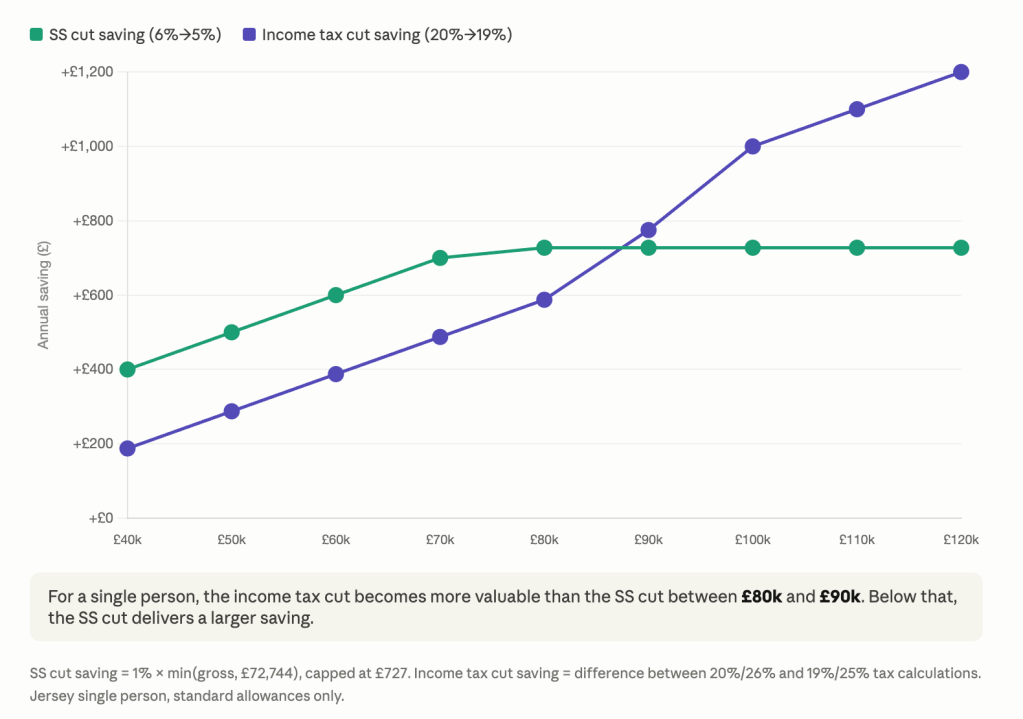
The huge advantage of a reduction in social security contributions is that it focuses the benefits on lower and middle incomes. This graph shows the financial benefit (vertical axis) for different levels of income (horizontal axis) that come from a 1% cut in social security contributions (green) versus a 1% cut in income tax (blue). It is clear that right the way up to an annual income of almost £90K, the social security cut delivers a better outcome. An income tax cut delivers more for those earning over £90K. In other words, a social security cut targets middle Jersey, whereas a cut in income tax is better for the wealthy. It also gives everyone the chance to respond the cost of living pressures they face in their own way, rather than giving handouts to specific groups (for example by cutting fuel duty, which does nothing for people who don’t drive or drive EVs).
We should in any case review the current social security contributions structure. The employer, employee and self employed rates all interact with the standard earnings limit, the upper earnings limit, and the higher earnings cap that could be fairer and potentially deliver lower rates for people on lower and middle incomes without damaging the social security reserve fund. This needs to include a review of whether there should be a cap on social security contributions.
Housing
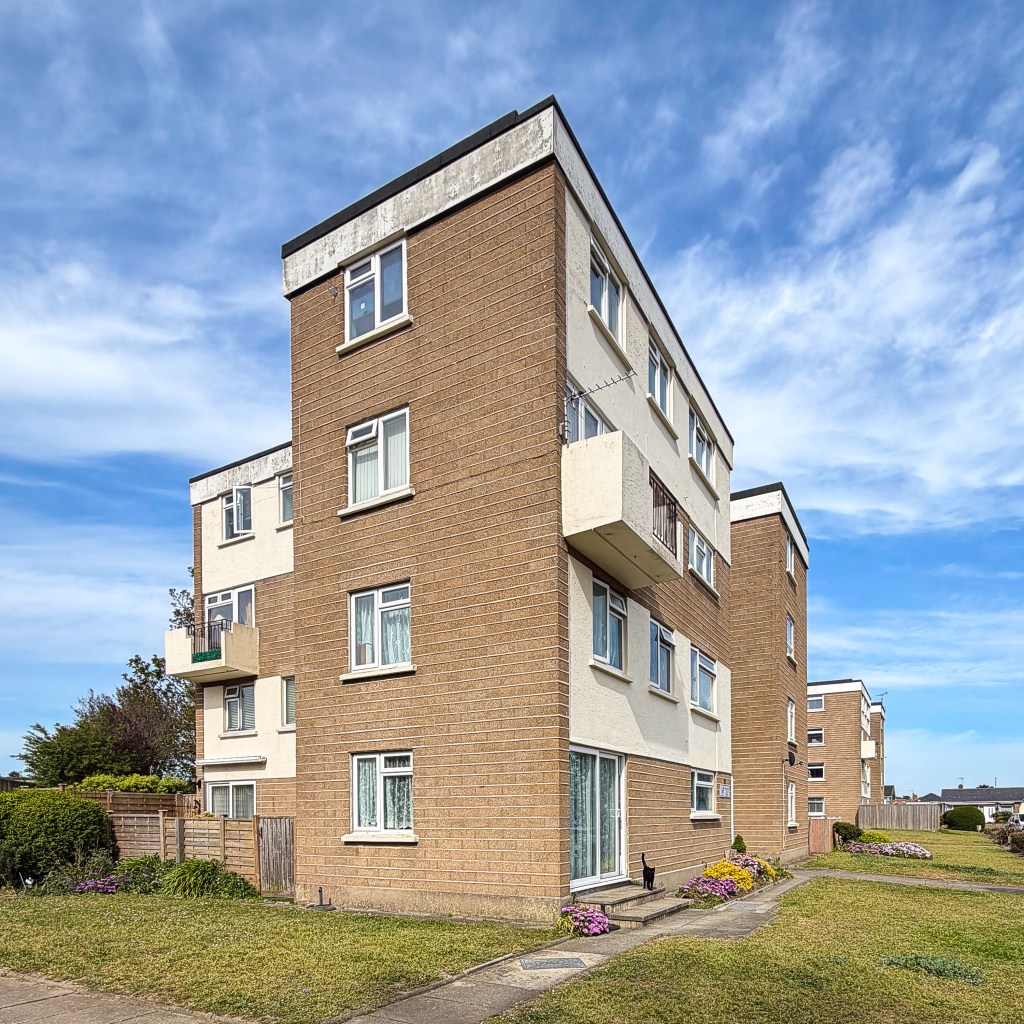
Despite a significant market correction over the last couple of years, house prices are still at historically high levels compared to earnings and rents are swallowing too much of people’s income. We cannot solve the housing crisis just by building more homes (crucial though that is); we need a comprehensive package of measures that increase affordability, meet demand for different types of housing and different tenures. But we must also tackle demand, including a population policy that means that demand does not continually ratchet up ahead of our ability to supply new homes.
I start from a fundamental principle. Housing is a basic human right. The inability to find housing at an affordable price has multiple negative impacts. In Jersey we know it is leading to people leaving the island, with considerable implications for our economy and for our society. But high housing costs also trap people in poverty, increase their sense of insecurity, and therefore ultimately undermine the economy. We are making housing so expensive that we risk losing a generation of islanders who give up on Jersey and move elsewhere. We also risk losing essential workers such as teachers and health workers who simply cannot afford to live here (or to move here). Lack of affordable housing is causing many businesses to struggle with recruitment and staff retention.
The private rented sector has expanded rapidly in Jersey over the last 15 years or so as home ownership has become more expensive. My aim is to encourage more home ownership because there is a huge unmet desire for people to gain the benefits in terms of security that owning a home can bring.
When in government, I took steps to try and deal with the housing crisis. I successfully piloted the licensing of residential dwellings legislation (often called landlord licensing) through the Assembly, after years of failed attempts. Although it was opposed by some landlords, it has bedded in well, and is helping drive up standards in the rental sector. I also worked with the then Housing Minister to try and deal with empty homes. Unfortunately, that work stopped with the change in government.
I supported the new government’s reforms to the Residential Tenancy Law, which brought in much needed protections for tenants. Responding to multiple representations from members of the public, I successfully proposed an amendment to the Housing Minister’s proposals to remove the 5% cap on rent rises (so that rent rises would be limited to no more than the rate of inflation), because it would have unfairly penalised landlords at times of high inflation.
I also supported measures – as promised in my 2022 manifesto – to remove mortgage interest tax relief for landlords, because it gives an unfair advantage to investors when they are bidding to buy property. That battle has yet to be won. I bear in mind (as a very small scale landlord myself) that the total returns to investors are still good in Jersey, not least because of long term (untaxed) capital gains and therefore we should not be giving tax incentives to property investors at a time when we are trying to make house purchasing more accessible for home owners.
Empty Properties
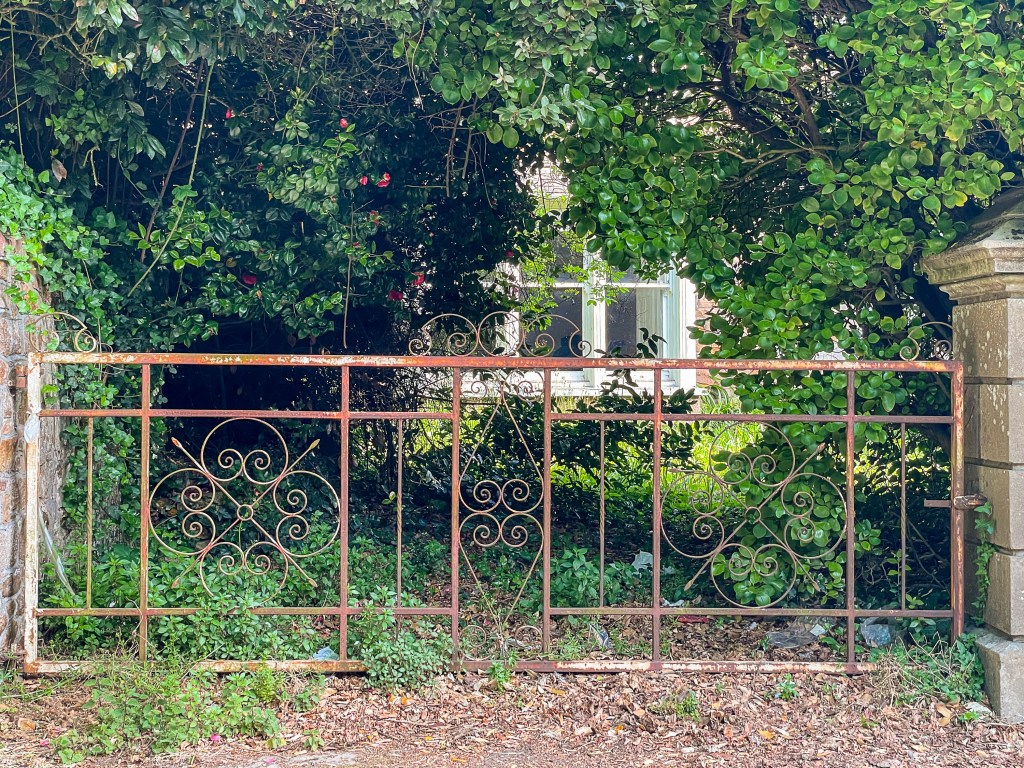
The 2021 census identified more than 400 empty properties in St Brelade and more than 4000 in the whole island. There are good reasons for some of those to be empty; someone has gone into care, recent bereavement, they’re awaiting planning permission and so on. But some are empty because the owner is happy to keep them that way. Analysis conducted by the previous government suggested that around 1000 of the 4000 empty properties are truly empty, in the sense that there is no clear reason why they are not lived in and they have been empty for a considerable time. At a time of extreme housing need, it is simply indefensible to allow this level of wastage. We need to tackle the problem.
In other jurisdictions, a number of incentives have been used to redevelop empty homes so they can be brought onto the market. Our first choice should be to work with owners to find out what prevents their property from being lived in and helping them to remedy the situation. One option would be to look at whether Andium could become involved and help fund renovation in exchange for a share of the rent or sale price. But if incentives fail, then we will need to look at penalising empty homes through the tax or rates system. The exact mechanism for achieving this, and the exemptions that would be necessary should be subject to consultation. It may also be possible that rather than an empty property tax disappearing into government coffers, it could be used to set up a specific fund to contribute to affordable housing. Another option would be for the tax to be administered through the parishes, with a proportion of the revenue raised going to each parish to set up specific funds run by parishioners for purposes decided by the community. But however we do it, this is a problem we simply must tackle.
Government, Tax and Spending
Government has grown faster than the economy on which it depends, and that cannot continue. But the answer is not arbitrary or deep cuts that slash services people rely on. We need to focusing on the identifying the outcomes we desire and then redesigning government around delivery of these goals. We need to root out waste, driving efficiencies, and establishing the principle that public spending should not outpace growth in the economy. We need cool heads, and the discipline to distinguish between what the state does well and what it does wastefully or shouldn’t be doing at all. Rebuilding the Stabilisation Fund and the Strategic Reserve are priorities, and we should avoid taking on more debt.
I support:
- A rigorous programme to establish government’s priorities and to identify and eliminate waste, redundant roles, and inefficiency across government — led by the CEO and based on proper analytical tools.
- Fiscal discipline in government – for which I have consistently voted in the States Assembly. I support the principle that government spending should not grow ahead of the economy, with the important caveat that economic shocks may require a temporary exception.
- Keeping government debt under control by resisting increases in government’s total debt burden beyond projects which have already been agreed.
- Ensuring that income taxes and social security rates do not rise for middle Jersey.
- Strengthening Jersey’s Strategic Reserve and the Stabilisation Fund, which both need replenishment. I will support using a meaningful proportion of any future surplus to rebuild them, in line with Fiscal Policy Panel advice, so that when the next economic shock comes, Jersey is in a position to weather it.
- A rationalisation of arms-length organisations, focusing their goals, reducing duplication and achieving savings through co-location and consolidation where this makes sense.
- Moving back to multi-year budgets to bring greater control and longer term planning over government spending. However, some annual flexibility must still remain in order to deal with changing circumstances.
- Measures to simplify government processes and reduce bureaucratic overhead, particularly where they impose unnecessary regulatory costs, making it easier and cheaper to do business. However, this must not be at the expense of public safety or environmental protection.
- The adoption of a Wellbeing Framework for Jersey — moving beyond GDP as the sole measure of success to focus on what really matters: health, community, environment, and economic security. This would embed long-term thinking into government decision-making, ensuring that budgets and policies are tested against the kind of island we want to be, not just short-term economic outputs.
- Examining the options for making Jersey’s personal tax system more progressive, in order to improve fairness and public confidence in the tax system without undermining our competitiveness, in line with the IoD/Chamber manifesto.
- Examining a targeted and limited expansion of the corporate tax base for financial service providers, again in line with the IoD/Chamber manifesto. This will need to be carefully designed so as not to harm the competitiveness of Jersey’s core financial services sector.
- If Long Term Care contributions have to rise (a 1% rise is scheduled for next year) then we must remove the earnings cap on LTC contributions. It is untenable to raise contributions for ordinary people and leave top earners with a lower effective contribution rate.
Details
Government spending has increased dramatically over the last few years, and so has the headcount. There are those who would say the answer is to slash government spending and/or jobs by an arbitrary figure. A 10% reduction in spending. A thousand job cuts. I don’t think this is the answer for two reasons. First, much of the increase in spending is driven by increasing demand for services – particularly funding health care and education which is where most of the increase in jobs occurred. And second, because arbitrary cuts risk cutting what you need rather than where there is waste.
I saw this in my time at the BBC. We’d have a round of job cuts. A specific number of job losses would be chosen. Then volunteers sought. And we ended up losing all the best people who knew that their job prospects outside were bright, whereas those that might have been under-employed – the ones we would have been better off losing – survived.
My view is simple. We need to root out waste and inefficiency in government. It is harder than an arbitrary target. You have to analyse what outcomes you wish to achieve and identify where there are redundant functions. And find poor performers. But there are recognised tools for performing this kind of analysis – for example a “span and layers” analysis or using outcome based accountability and ensuring proper staff performance appraisals. That is the way to set up government for focused delivery on clear objectives.
We need to bring spending back in line with income. I voted consistently for this principle in the States Assembly. But it is a fantasy to think that we can dramatically reduce government spending. We need to make savings, yes, but those savings will overwhelmingly need to be re-invested to help us meet the growing demands on spending that are driven by an ageing population, increasing costs of healthcare, the need to offer childcare support, investment in critical infrastructure, rising demand for SEND provision and so on. Jersey cannot build its resilience or deliver on the promise of a safe harbour if it is not funding services on which people depend and investing in infrastructure that will boost the productive capacity of the economy.
There has been a significant increase in spending on arms length organisations over the last few years. We need to drive efficiencies by rationalising the number of organisations, reducing duplication, saving money through co-locating and managing their performance. But I do not believe in slashing the number of organisations for the sake of it – many of the roles they perform will need to be done whether it is by an arms length organisation or by government taking the roles in house. There are also vital regulatory functions that must continue because they respond to serious issues that have arisen, which is why we have the Children’s Commissioner and the Care Commission. Careful pruning and rationalisation, with clearer objectives and “right sizing” to those objectives are where we should be focusing our efforts.
Environment and Planning
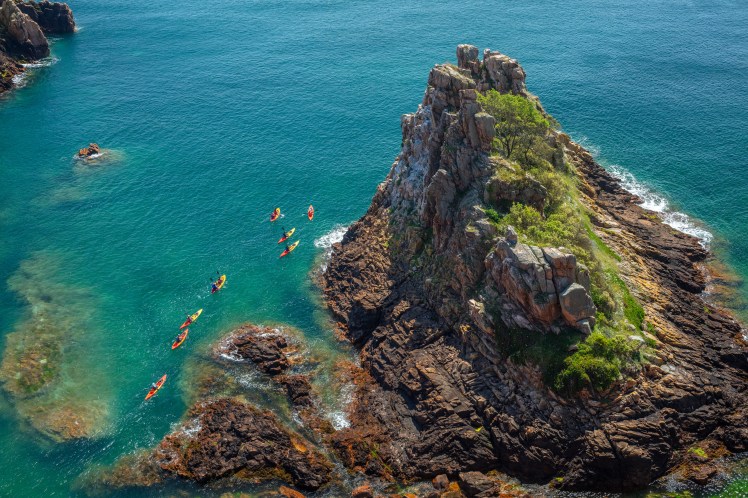
Protecting Jersey’s natural environment is not just the right thing to do — it is the foundation of our long-term prosperity. During my first term I promoted the idea of “Green Growth Jersey”, to highlight how sustainability can be the foundation of our future economic development. I stand by that ambition.
I am proud of the progress made during my time as Environment Minister, but there is significantly more to do. The next Island Plan must embed ambition on biodiversity and urban greening. The planning system must become simpler and more responsive, but we must resist the temptation to sacrifice hard fought environmental gains for short term profit.
I support:
- Robust protections for Jersey’s natural environment and heritage, with particular focus on the coast, the countryside, the green zone and our most sensitive habitats.
- Biodiversity net gain and urban greening — including the creation of more green spaces such as ‘pocket parks’ in St Helier — as central goals of the next Island Plan.
- Enhanced protection for the marine environment, including further measures to safeguard ecologically sensitive habitats such as maerl beds, in the long-term interests of both the natural environment and the future of a sustainable fishing industry.
- The findings of the scientific advisory panel on PFAS, which I helped establish as Environment Minister. However, decisions on when to phase in tighter limits on PFAS levels in the public water supply should be taken once we have a full understanding of the best available technology and a realistic implementation timeline.
- A tax or charge to capture a proportion of the increase in land value when land is rezoned for housing or other development, so that the community shares in the planning gain that comes from development decisions. This must be in place before further rezoning of land occurs.
- Jersey’s decarbonisation pathway as outlined in the carbon neutral roadmap – as I did when I was the responsible minister – because it is an opportunity on so many levels. The crisis in the Middle East, following so quickly after the Ukraine war price shock has made the case for weaning us off fossil fuels unarguable. Decarbonisation has multiple co-benefits – for example, better air quality, lower home heating bills, greater economic resilience and reduced congestion – as well as being a springboard for sustainable economic growth.
- Making solar panels on new buildings mandatory (except where exceptional circumstances make it unviable). I also support limited use of ground mounted solar on lower quality agricultural land where the visual impact can be limited.
- Maintaining the current system of planning appeals against those who would restrict or abolish the right to appeal against a planning decision.
- Tightening the planning law to stop the ability of applicants to submit virtually identical planning applications to an application that has been refused.
- I support only limited development of glasshouse sites. I outlined my views on this in a blog post.
Protecting the environment and supporting the economy
Promoting economic development should go hand in hand with protecting the environment. Ultimately, the health of the economy depends on the environment; farming needs healthy soils, tourism needs a beautiful environment, even the finance sector needs an island that is an attractive place to live and work. That is why we have a Department for Sustainable Economic Development.
There is often a temptation to make environmental sacrifices on the altar of economic development. And sometimes that is right and necessary. But we always need to consider the wider consequences before making those sacrifices. When the waterfront was being reclaimed, environmentalists argued that it was wrong to use fly ash from the incinerator as part of the fill. They were right. Now, development of the Waterfront will cost tens of millions of pounds more than it should because of the need to excavate and safely dispose of the contaminated material.
There will always be pressure to develop land in Jersey – it is scarce, and the potential economic benefits are often considerable. But that is why we have an Island Plan with a hierarchical series of policies that allow development to be considered in a structured framework. Some of these policies end up pointing in different directions on the same planning application, but this is not a failure, it is how planning policy works; careful consideration of competing policies with a measured judgement based on an assessment of the relative weights of the arguments. In this context, I will not support any attempt to bypass the Island Plan – for example to provide a green field site for a so-called “budget” supermarket. All development proposals must be judged against the comprehensive policy framework in the current Island Plan.
Some people regard the planning process as a barrier to economic development – I regard it as an essential tool to reaching balanced judgements on controversial planning applications. The biggest application decision in which I was involved as minister was turning down the JDC’s waterfront plans. The reasons for that decision were set out clearly with reference to the relevant policies. Others may disagree with the decision, but at least they can see the reasoning.
That is not to say that we should not be aiming to improve our planning system, to make it easier and quicker to navigate. I began that process as minister by bringing in an outside expert to benchmark our planning services, and I used his recommendations to begin a far reaching programme of reform. My successor continued down the same road. I support further simplifications in the planning process. For example, we should look at a “trusted trader” scheme, where accredited agencies or companies could be assumed to have permission to undertake certain types of work that currently require planning permission. Jersey Heritage for example could be a “trusted trader” when it comes to repairs to listed buildings in their estate. We should simplify the document requirements for planning applications. Examine whether “permitted development” rights can be further expanded, avoiding the need for planning applications entirely.
However, I am very aware from my time as minister that for every letter received complaining about over rigid planning processes, I got at least one other letter from someone complaining that policies needed to be tightened because development that was perceived as harmful was going ahead without a way to stop it. Similarly, there are multiple complaints that enforcement is too weak. Planning policy is a difficult balance and as politicians we should respect that complexity rather than pushing “quick fixes” that might have detrimental impacts. For example, I would resist attempts to remove the public’s right to make appeals against planning decisions.
Marine Protection
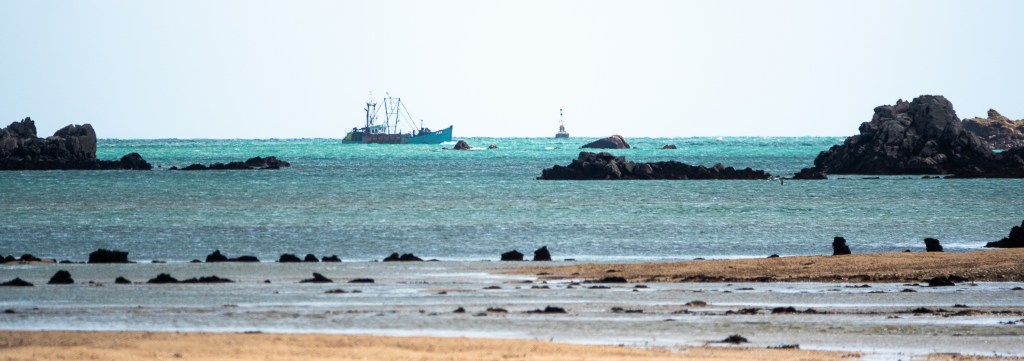
Unfortunately over recent years we have pursued overly aggressive exploitation of our fish stocks, such that stocks of almost every commercial species have collapsed. Although we have increased the coverage of our marine protected areas (through the Marine Spatial Plan that I introduced), my successor as minister reduced the area that had originally been proposed for protection. The result is that we are continuing to destroy incredibly valuable marine habitats through bottom dredging – ultimately to the long term detriment of the fishing industry. I will campaign to extend the marine protected areas to include those areas of seabed that have been identified as of high ecological value. And I support the ecologically sustainable scallop diving industry which could be the basis of a high value, environmentally friendly fishing industry.
Decarbonisation
The carbon neutral roadmap remains a vital document to guide Jersey’s future development (along with the exemplary recent Climate Council report). It is tempting in times of economic crisis to put long term commitments to one side, but in fact the case for decarbonisation has only been strengthened over recent times. The war in the Middle East (following so soon after the Ukraine war) has shown how vulnerable we are to external oil price shocks over which we have no control. Decarbonising helps insulate us from fossil fuel price hikes, reducing the cost of living and builds our economic resilience. All the things we need to do to decarbonise are “no regrets” policies – they are things we would want to do anyway. Insulating our homes, choosing more active sustainable transport options, installing solar panels on new build properties (and retrofitting where possible) and improving air quality, to name but a few.
Given that EVs are now cost competitive with petrol/diesel vehicles (particularly once running costs are taken into account), we can afford to focus our decarbonisation incentives more on home heating and insulation – measures which also reduce the cost of living. The Climate Council report offers much sound advice on the way to get the most “bank for our buck” in terms of how we deploy the climate emergency fund.
And if Jersey is to be a “safe harbour” where long term thinking is prioritised, then that makes the case for sustained decarbonisation even stronger. Of course, we can and should debate the exact mix of incentives and they will change as different technologies mature. But decarbonisation pays for itself many times over as well as delivering multiple co-benefits, so it is important that we stay the course.
Sustainable Economic Development
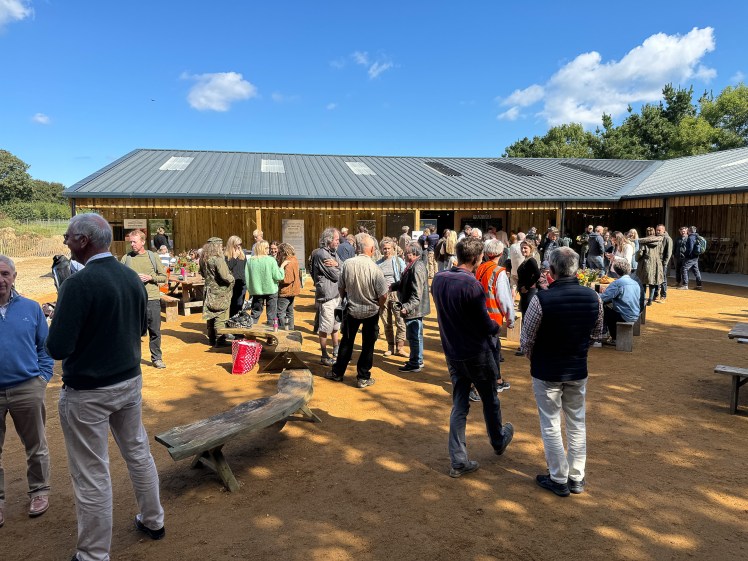
Jersey’s economy faces considerable headwinds — stuttering growth, a heavy reliance on finance, and the twin pressures of an ageing workforce and rapid technological change. The answer is not to search desperately for growth at any cost, but to build on our strengths: a world-class finance sector, a remarkable natural environment, a creative economy, and the potential to be nimble in developing new sectors. We need to become an island of opportunity, but built on social purpose, environmental protection and shared benefits. Resilience and diversity are my watchwords.
I support:
- Jersey’s financial services sector which generates half our GDP, funds our hospitals, our schools, and our social security. The recent “Time to Win” action plan to keep Jersey competitive as an international finance centre is a strong basis on which to go forward.
- Pursuing the significant and growing opportunity in sustainable and green finance — an area where Jersey’s reputation for quality regulation and political stability gives us a competitive edge.
- Continued efforts to develop an offshore wind farm in Jersey’s waters, subject to securing a viable export market and private sector funding, as a major opportunity to create skilled jobs and generate tax revenue. I will support using a proportion of any wind farm tax revenue to subsidise islanders’ electricity bills.
- Increasing resilience by expanding and diversifying food production supported by government investment through the rural and marine support packages.
- Driving digital and AI adoption so that Jersey catches the next wave of economic opportunity, rather than being drowned by it. We should build on the “AI Playbook” recently published by Digital Jersey, which provides a solid foundation on which to build adoption of AI in Jersey, both the private and public sectors.
- Measures to make it easier to do business in Jersey and to encourage investment in productivity and digital innovation, including developing a dedicated AI strategy for business and government.
- Development of the Island of Longevity project as a means of turning Jersey’s ageing demographic into a genuine economic and social asset.
- Sustainable development of Jersey’s tourism sector, focused on quality, uniqueness, and our extraordinary natural and heritage assets rather than volume. This includes simplifying and speeding up planning decision making, but without compromising the protection of our environment that is the foundation of what makes Jersey special.
- Jersey’s creative economy, recognising its contribution to our cultural life, our identity, and our economic diversity. Economic support could be expanded through explicitly including the creative sector in the Better Business support package.
- The broad thrust of the recent IoD/Chamber of Commerce manifesto which captured many good ideas around which government, business and the third sector can unite.
We need to become an island of opportunity again, for businesses to flourish, to give hope to our young people and because it is the economy that funds the services on which we all depend. Business is telling us loud and clear that it finds trading in Jersey more difficult than it should be. I worked in an internationally competitive industry all my career, so I know the value of quick decisions, acting fast and taking chances. Innovation and excellence were the cornerstones of my approach to my work and they are the foundation of economic success in a world where we have to fight to compete.
My support for an innovative, dynamic economy sits alongside my commitment to the environment and to a well regulated society – the two should not be in opposition. That is why I believe that we should adopt measures to make it easier to do business but remain careful in ensuring we do not throw the baby out with the bathwater. Good regulation doesn’t just protect citizens it provides a framework in which business can operate safely without bad operators undercutting the good. So yes, we need to simplify regulation and we should be determined in ensuring that we regulate in a way that is as light touch as possible, but commensurate with the goals that regulation is seeking to achieve.
There is no question that the focus for the next Assembly is going to have to be on kickstarting the economy. I am willing to talk to anyone in the business community about their take on what that will require. Many of the best ideas will come from those on the front line.
A Jersey wind farm
As Minister for the Environment, I brought forward plans for a utility scale offshore wind farm, totalling approximately 1GW in capacity, built by a private sector consortium. The aim was to develop an entirely new economic sector, with significant economic diversification achieved at a stroke. The principal benefits to the island would be the tax take from the profits of the wind farm operator, jobs in construction and then in ongoing maintenance and logistics. There are also future benefits that could derive from Jersey becoming a hub for generating low carbon electricity (for example if tidal power becomes economically viable) and also a hub for the complex trading mechanisms that will be developing as Europe decarbonises.
The project depends on gaining market access either in the UK or in France and given significant acceleration in decarbonisation efforts in both jurisdictions, it is likely that a Jersey wind farm will very much be on the agenda for the next government. I would favour using a proportion of the tax take to directly reduce the price of electricity in Jersey, to establish a direct consumer benefit from the establishment of the wind farm.
I know there are those who are opposed to a wind farm on the grounds that it will spoil the view to the west of the island. All I would say is that we are going to see a wind farm off St Ouen’s whether we have a wind farm or not. The French have made it clear that they plan to build a wind farm to the west of Jersey, right up to the boundary of territorial waters. If we’re going to see wind turbines anyway, it surely makes sense for us to gain some economic benefit.
However, my support for a wind farm is – as I have always said – caveated by the need for whatever deal is eventually on offer to be a deal that works for Jersey. If the benefits are not significant, then there is no point in going ahead.
Infrastructure
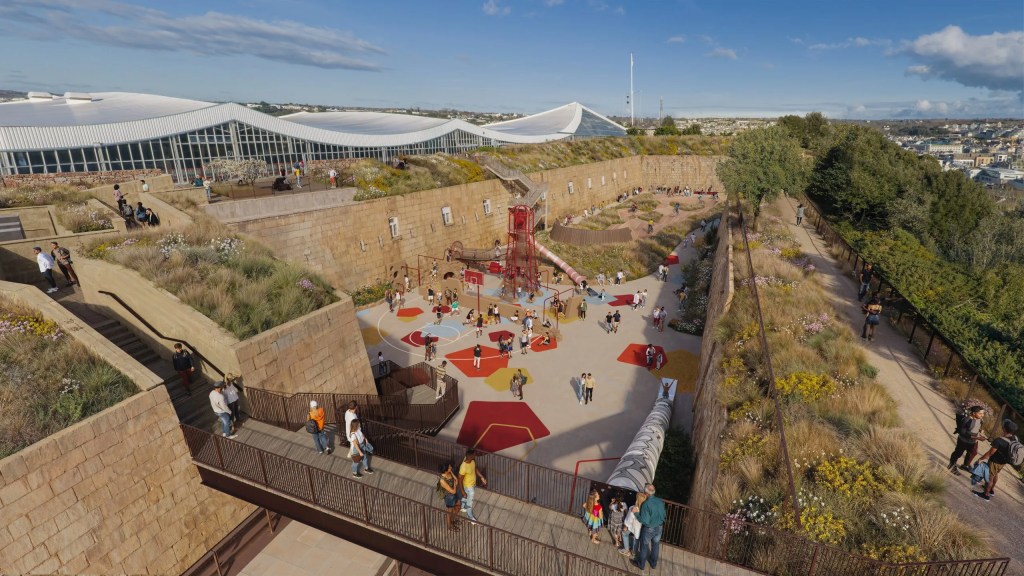
Jersey has a long legacy of underinvestment in infrastructure, and we are living with the consequences: a liquid waste network that cannot accommodate new housing development, a long list of deteriorating government-owned assets, and Fort Regent standing as a visible symbol of neglect. Both governments of the last four years made progress on correcting this, culminating in the creation of the Capital Investment Fund and, at last, a credible plan for Fort Regent. That momentum must not be lost. But good infrastructure is not just about replacing what is broken — it is about building an island that works better for everyone, that supports economic development, with safer streets for cyclists and pedestrians, and delivers a waste strategy that is fit for the future.
I support:
- The Capital Investment Fund as the right mechanism for long-term, disciplined investment in Jersey’s infrastructure — ring-fenced from short-term spending pressures.
- Plans for Fort Regent’s redevelopment, while insisting that costs are properly controlled, that it does not add significantly to the island’s debt burden and that the community remains central to shaping what it becomes.
- Sustained investment in replacing and upgrading critical infrastructure assets, including liquid waste where past failings directly constrain our ability to build the homes Jersey needs. I will consider supporting the introduction of a liquid waste charge to fund these essential upgrades but I am open minded about the best way to achieve this. Any scheme must be subject to proper public consultation and designed fairly, so that charges reflect actual usage rather than simply penalising those who live in larger properties.
- A serious programme to improve cycling and pedestrian infrastructure across the island, particularly the “safe routes to schools” programme. Road improvements focused on public safety must also be a priority.
- A step change in Jersey’s recycling rates — which remain woefully low by any international comparison — including the introduction of food waste recycling. Reducing the volume and improving the composition of what goes into the Energy from Waste plant is the most effective way to extend its operational life and avoid the enormous capital cost of building a replacement. Again, consultation will be key.
It is by now very well known that Jersey has over many years failed to invest in its vital infrastructure and lacked long term planning on future investment. The government has taken important steps to correct this by setting up the Capital Investment Fund (which I supported). Now the next government needs to deliver the sustained investment combined with a long term plan for future projects. After the catastrophic failures over the hospital, the island badly needs a sustained period of efficient delivery of infrastructure projects. The immediate pipeline is clear, and includes the Overdale hospital, the new town school and Fort Regent. Beyond that, a replacement for Highlands (in St Helier) is on the agenda. We need to make a major drive to improve our recycling rates so that we can extend the life of the incinerator (energy from waste plant) and then plan for either a much smaller replacement or to do without an EFW entirely. We need an integrated water management plan and I believe we should investigate treatment of waste water from Bellozane with a view to feeding it back into the water supply.
Young and Old

Jersey faces a demographic challenge that conventional thinking turns into a crisis: too many older people, too few young ones. This needs a rethink. An island where older people remain healthy, purposeful and connected is a more resilient, cohesive and productive place. That means tackling pensioner poverty with targeted help and working towards the concept of a “living pension” (just as we aim to have a living wage). And an island that gives young people a proper chance to build their futures here — to buy a home, start a career, and put down roots — is one that retains the energy, talent, and civic commitment it needs to thrive, as well as paying for the services that will sustain the elderly. The young and the old should not be competing priorities because policies that serve both will benefit the whole community.
I support:
- The development of the Island of Longevity project as a starting point for turning our ageing population from what is often perceived as a liability into an asset — keeping people healthy, active, and contributing for longer.
- Supporting pensioners by targeting help towards those who most need it and working towards a living pension, in the same way we aim to have a “living wage”.
- Developing a dedicated financial incentive to help young Islanders save towards home ownership or a rental deposit, shaped by consultation with young people, Treasury and local banks.
- Measures to make it easier for young people who have left Jersey to return — including through housing and tax policy (for example income tax holidays) and active engagement with the diaspora.
- Measures to keep older workers active in the economy for longer, supporting flexible working, phased retirement, and removing barriers to continued employment.
- Improved mental health provision for young people, recognising the rising demand and the inadequacy of current services.
- Developing a “participatory budgeting” scheme to give young people a genuine voice in decisions that affect them.
Tax incentives to help the next generation

I am a huge believer that people should explore the world, and young people who want to leave the island in search of new experiences should be encouraged to do so. However, at the moment too many young Islanders leave not out of choice but out of necessity – they see no future here. And too few return. The reasons are well-documented, but housing sits at the heart of it: for a working household on an average income, owning a home in Jersey is all but out of reach. That is a failure that costs Jersey skills, enterprise, and civic energy it cannot afford to lose, given the pressures of an ageing population and a narrowing tax base. Quite apart from the dispiriting burden it places on young people whose dreams are crushed by unaffordable house prices and high rents.
In addition to the measures mentioned in the housing section, we should explore the creation of a dedicated financial incentive — rooted in the tax system and linked to long-term savings — that sends a clear signal to young Islanders: if you build your life here, Jersey will help you build towards owning a home. Guernsey has looked at something along these lines. It would work by creating a savings account where the interest is tax free, so long as the money in the account is used for a house deposit. Income deposited into the account could also be tax deductible. There is a range of ways a Jersey scheme could be designed and it would need buy-in from one or more financial institutions, but this is an idea that deserves exploration.
Island of longevity
By conventional thinking, Jersey’s greatest long-term vulnerability is an ageing population that means fewer workers supporting more dependants, rising health costs, and growing pressure on public finances. The Island of Longevity initiative reimagines ageing and the role of community, government, and individuals in shaping a future for Jersey where living beyond 100 becomes the norm. It is a really strong example of how a community initiative has galvanised new thinking.
A society where people remain healthy, purposeful and connected well into older age is not just a nicer place to live; it is a fundamentally more resilient one. It has a broader base of economic participation, lower preventable healthcare costs, and stronger community bonds that act as shock absorbers when times get hard.
What I particularly like about the project is the way the different elements reinforce each other – an idea that crops up throughout my manifesto. Healthier people stay in work longer, easing the dependency ratio. People with purpose and social connection are less likely to make heavy demands on health and social care services. Communities with genuine intergenerational ties are more cohesive and better at self-organising in a crisis. An economy measured by wellbeing as well as GDP is one that takes seriously the conditions — housing quality, work-life balance, green space, belonging — that sustain all of the above. The task now is to start embedding this kind of thinking in decision making – in government but also throughout society.
A budget for young people
Jersey suffers from a lack of political engagement from young people. Good work has been done by the States Greffe to reach out to schools and build greater awareness and knowledge of local politics. I have enjoyed many visits to island schools during my term of office either as learning experiences or as part of political outreach work. But the truth is that many schoolchildren are still distant from politics. One mechanism that could generate greater involvement is participatory budgeting.
It is a straightforward idea: a defined pot of public money is set aside, and young people decide — through a structured, deliberative process — how it should be spent. Participatory budgeting has been tried successfully in many places and there are many different ways in which it can be organised. The sums involved need not be large to be meaningful; what matters is that the process genuinely involves young people from the start, identifying priorities, deliberating with peers, and the choices themselves.
The case for doing this is partly practical and partly about trust. Practically, young people often have the clearest sight of what is missing from their communities — facilities, services, spaces — precisely because they are the ones not being served. But the deeper argument is about civic engagement. A generation that has experienced public money being spent on their priorities, through a process they shaped, is more likely to remain invested in the democratic institutions that govern them. The exact nature of the participatory process is up for grabs – there are many alternatives. But in an island where young people too often feel that decisions are made for them rather than with them, an experiment in participatory budgeting is worth a try.
Education, Skills and Lifelong Learning
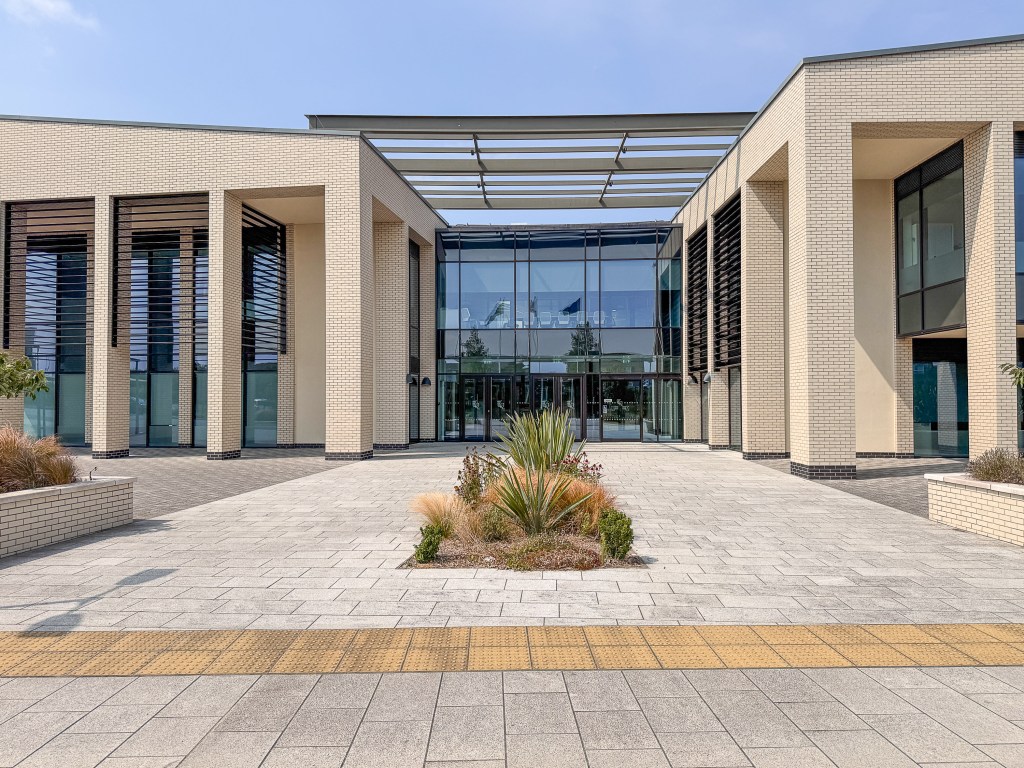
Jersey’s schools deliver good outcomes and teachers perform wonders under considerable pressure. But we should aim higher. Our education outcomes are only slightly better than the UK’s — and that is not good enough for an island with our resources and ambitions. The education system is fragmented with the best results concentrated in the fee paying sector. From early years through to post-16 and lifelong learning, we need a rethink, to redesign the system so that everyone can reach their potential and keep developing throughout their lives. We need to replace the current facilities at Highlands with a modern, purpose built college (probably in town). Schools need more support for dealing with SEND issues, with the current backlogs in assessment for spectrum disorders causing significant problems for schools and storing up future problems (because issues go untreated problems worsen before treatment is finally available).
I support:
- A review of Jersey’s post-16 education system to ensure the pathways available to students reflect the demands of the modern economy and the needs of today’s learners. This should include considering the provision of 6th form facilities at state secondary schools.
- The modernisation of Highlands College, most probably through relocation to a town site, to provide facilities that are fit for a high quality further education offer.
- A balanced approach to falling primary school rolls that considers how savings from surplus capacity can be reinvested to improve educational provision before making cuts.
- Significantly improved provision for pupils with Special Educational Needs and Disabilities (SEND), recognising that current provision is inadequate and that the demand is growing.
- Continued investment in supported childcare provision as a means of enabling workforce participation and giving every child the best start in life.
- Jersey’s ambition to become a beacon of high educational performance — not just slightly above the UK average, but significantly outperforming the UK.
Society
We need to think hard about what kind of society we want to be. We absolutely need to revitalise our economy, but not everything comes down to economic growth – our island identity and social cohesion are also vital to who we are. That means continuing to increase the minimum wage until it matches the living wage.
Jersey is and always has been, a welcoming island, built on immigration. But when population grows faster than our ability to build homes, schools and infrastructure, the result is rising costs and overstretched services. Despite the temptation to increase immigration to deliver economic growth, I believe we should maintain strong controls on immigration in order to ensure that population does not increase ahead of our ability to cope with rising numbers. It is also the case that rising immigration does not automatically make the island richer – per capita economic growth hardly rose at all during the years of high immigration. The same logic applies to High Value Residents: done well, HVR immigration brings a significant economic contribution, done badly it drives up property prices, strains public trust, and undermines our social fabric.
Jersey still has a long way to go to meet the ambitions of the Care Inquiry, with too many vulnerable children not getting the care and support they need and safeguarding issues remain a significant concern. I will support improvements in services and care to make good on the promises of the Care Inquiry. We must also work to ensure that the gathering evidence of social harms around children’s exposure to social media is controlled, through legislation if necessary.
And underpinning social cohesion is a simple principle: a cohesive society requires that citizens feel they can get independent redress when things go wrong. The current complaints panel does sterling work, but every major report on the subject for the past twenty years has reached the same conclusion — Jersey needs a fully independent Public Services Ombudsman.
I support:
- Continuing to increase the minimum wage towards the living wage over the course of the next political term, with appropriate short term compensatory measures for businesses to manage the transition, subject to appropriate economic advice.
- The establishment of a secondary pension, similar to the “Jersey Pension Saver” that was proposed by the previous (Moore) government.
- Making it easier for employers to find the people they need where those needs cannot be met on island, because we all benefit from the injection of new skills and the filling of vital roles, particularly entrepreneurial talent. However, the qualification is that we need an immigration policy that keeps control of population. I support a population policy that aims to maintain the working age population.
- Capping new High Value Resident admissions (at around 15 per year); using the next scheduled review of the HVR scheme to raise the minimum tax contribution, index it to inflation, and ensure that voluntary contributions (such as the £100K charitable contribution) are mandatory. (However, I am open to considering other ways in which the HVR contribution could be structured to help deliver economic benefit and social value.)
- Building deeper partnerships between government, business, the third sector, and social value enterprises — along the lines of the One City model in Bristol — so that the island’s collective resources are better aligned around shared goals and responsibility for the delivery of our objectives.
- Ensuring that where government relies on charities or other organisations to deliver public services, they are treated as strategic partners, with multi year funding and regular consultation to ensure productive, long term relationships.
- The establishment of a Public Services Ombudsman: the evidence from other jurisdictions is clear — independent redress mechanisms reduce costly litigation, drive improvements in service quality, and save money in the long run.
- Recommitting to the Putting Children First agenda that grew out of the Jersey Care Inquiry, because there is still a long way to go to ensure that children – particularly vulnerable children – are given the care and support they need.
- Promoting sport in our schools, particularly our primary schools, to increase levels of activity, build fitness and health from a young age and thereby reduce dependency on high cost health services in later life.
- Creating a proper, structured relationship with the Jersey diaspora, to maintain long term links with the Jersey community abroad, both to ensure Jersey is well represented around the world and to offer opportunities for people who may have lived and worked abroad to return home.
We are lucky to live in a diverse community with many different strands that makes Jersey a society with depth and a richness that is extraordinary for our small size. Over recent years, the island has taken welcome and positive steps towards further social inclusion and overcoming structural biases in society, from independent taxation to the implementation of the landmark Violence Against Women and Girls Taskforce recommendations.
But it is also true that there are significant and growing pockets of economic hardship and social exclusion. The position of vulnerable immigrant groups was starkly highlighted by the appalling death of a worker who died trying to warm himself by lighting a fire in a portacabin. Similarly, we know that use of food banks has exploded, and charities working with people on the margins of society are continually sounding the alarm about a rise in hardship. In an island with so much wealth, that is a shameful situation.
My starting point is that everyone in Jersey should have the opportunity to flourish. Quite apart from the personal hardship involved, people who are struggling to keep their head above water are not able to contribute properly to society. So how do we do that? Government can work more closely with charities and other organisations working on the front line to design policies. We should continue to increase the minimum wage to the living wage, because the gap between incomes and living costs is the fundamental driver of poverty. At the same time, we need to consult with business to ensure that they have time to adjust (and if necessary support short term adaption measures). The direction of travel should be clear however – Jersey’s economy needs to move towards being based on wages that allow people to live with dignity.
Population
Although there will always be a temptation to increase immigration to boost the economy, we must remember that the key metric we should be targeting is not growth per se, it is growth per capita. An economy that grows at the same rate as the population expands is not increase our collective wealth. Therefore, our immigration policy needs to be carefully targeted to meet the need of the economy to fill labour gaps and boost growth sectors. Jersey is a small island and I do not support a big increase in immigration rates, which creates pressure on physical and social infrastructure whilst creating long term liabilities in health and pension costs.
High Value Residents
In terms of HVRs, there are considerable benefits from welcoming a small number of HVRs to the island each year. They bring skills, capital and energy that benefit the economy and can help us diversify as well as strengthen our core industries. However, I believe that we should carefully control the numbers because there are dangers in being “overweight” in HVRs. They can have inflationary impacts on some areas of the economy, gain excessive political influence and there is an impact on social cohesion about which we must be mindful. I support an independent analysis of the costs and benefits of the HVR programme as a way to right size the programme and to build wider public support.
If we are to realise the benefits of an HVR programme we need to ensure that the HVR community is integrated into our broader social and economic objectives. The next iteration of the HVR programme should therefore be more explicit in what we expect from HVRs, with the current voluntary approach to charitable donations made compulsory. I am open to considering other forms of contribution, but whatever they are, they should be compulsory. I also believe that the tax contribution should be significantly increased and indexed to inflation. To those who say that we risk driving HVRs away, I would say we are not in competition with Dubai or Italy. We should aim to be a niche market focused on those who want to become involved in Jersey and who value safety, proximity to the UK and our “Britishness”. We have a good product and we should price it accordingly.
Health
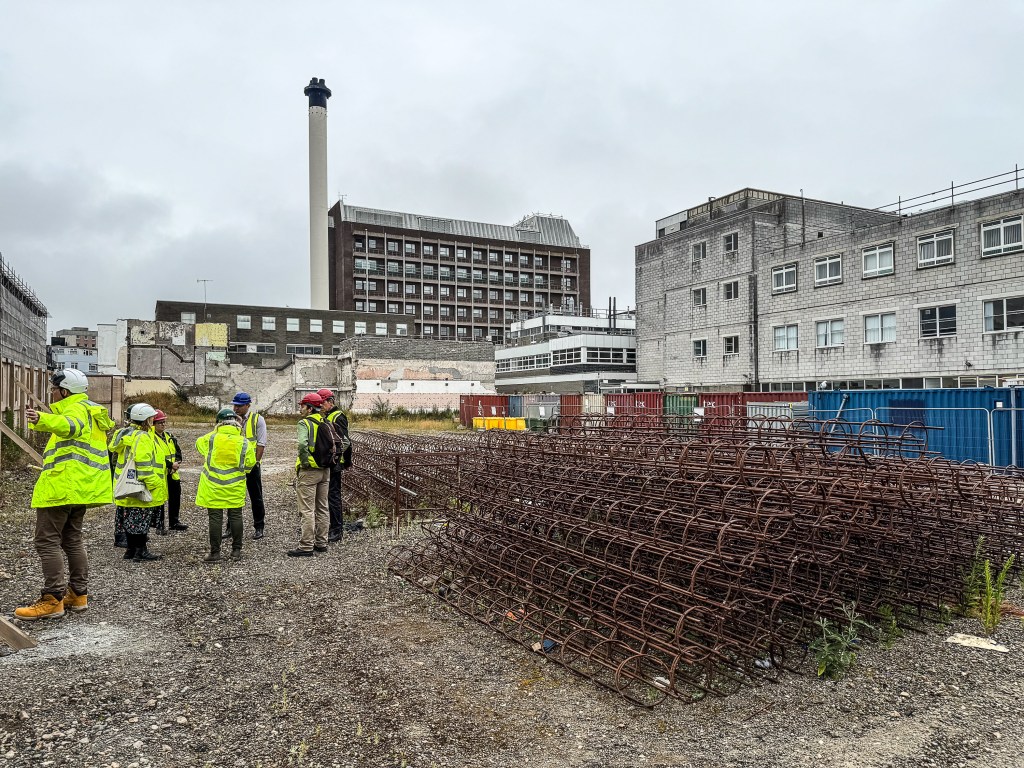
Jersey’s health service faces serious financial strain, with spending up 50% in four years, persistent budget overruns, and both the Long Term Care Fund and Health Insurance Fund forecast to be exhausted within a few years. Health funding is therefore the central fiscal challenge for the next government. Despite dedicated staff working hard in often difficult conditions, waiting lists remain unacceptably long in some areas, and repeated external reports have highlighted pockets of poor practice and resistance to change. Our future health strategy must be grounded in financial discipline and value for money. I am therefore extremely sceptical about plans to expand the health estate further when consolidating services on existing sites is likely to be cheaper and more efficient. Above all, Jersey needs a fundamental, wide-ranging review of how health services are funded and delivered, based on the principle that no one should be denied care because of their ability to pay.
I support:
- Continuing to benchmark our health services against best practice elsewhere, through Royal College reviews or similar mechanisms, until the Jersey Care Commission takes over regulation of HCS services.
- A fundamental review of health strategy and funding, with all options on the table so long as the principle that no one should have access to healthcare restricted because they cannot afford it is respected.
- Consolidating the hospital estate to achieve greater efficiencies and lower costs, rather than expanding onto new sites.
We are fortunate to benefit from many dedicated, caring professionals working in our health service – in HCS, in the primary sector and in charities and other delivery partners. They work wonders in a dilapidated hospital and often without the resources they would like. But just as in many parts of the world, health services remain a critical problem for the island.
Spending has risen by around £100m or roughly 50% in just four years, and yet the department has still repeatedly overspent even its enlarged budgets. Both the Long Term Care Fund and the Health Insurance Fund are forecast to run out within the next few years. Add it all up and health funding is the central fiscal challenge facing the next government.
In addition to the budgetary issues, waiting lists in some areas are still way too long (ludicrously so in the case of ADHD diagnosis). And that is notwithstanding huge efforts to improve. Meanwhile, report after report have exposed persistent pockets of poor medical practice and resistance to change. It is encouraging that HCS is developing links with centres of excellence in the UK, which points the way to a more efficient delivery of services, where Jersey benefits from expertise without having to employ clinical experts who may be under employed because of Jersey’s small population.
We need stringent financial discipline in health spending. Efficiency savings are vital, and it is a shame in this regard that the government chose not to extend the work of the expert brought in as part of the turnaround team to sort out HCS’s services. Every decision about health needs to be taken through the lens not just of whether something is desirable, but is it the best value option.
As an example, once we have built the acute hospital at Overdale, we will be left with a very large site at Gloucester St and Kensington Place. The current minister has plans to add further to the health estage by buying fields in St Saviour to build yet another hospital, focused on mental health facilities (the so-called health village). I do not doubt that a very nice mental health facility could be built in St Saviour, but the development of the rest of the health estate needs to be seen through the lens of value for money. It would surely be cheaper to consolidate all the remaining health services in town on the existing site, where duplication of facilities and services can be avoided. The efficiencies of co-location are well known which is why hospitals are tending to get bigger, rather than fragmenting into smaller units.
Looming over all this is the need for a debate about the future funding of health services. We need a fundamental review of how health services are provided and funded. It should be wide ranging, with all options on the table, so long as the fundamental principle that no one should have access to healthcare restricted because they cannot afford it.
How to vote
You can vote both by post or in person, as long as you’re registered. For more information, visit www.vote.je/how-do-i-vote/.

