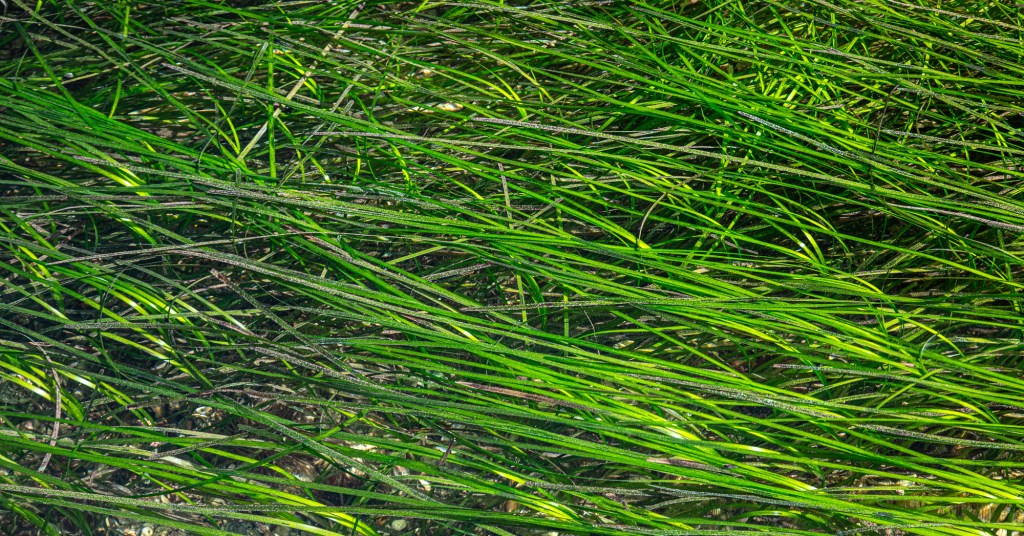
Sea grass just below the surface, Violet Bank, south east coast, Jersey
This is a letter that was sent to all States members a week ago by a group of eminent scientists, urging support for amendments to the Marine Spatial Plan that would reinstate the marine protected areas as originally proposed. The argument they advance is compelling and backed with evidence. We must protect the most ecologically important habitats if there is to be a sustainable future for fishing in Jersey.
14 October 2024
Dear Deputy/Connétable,
We are writing to you to support the adoption of amendments to the Jersey Marine Spatial
Plan (JMSP) to increase the extent of protected maerl habitat.
The JMSP includes the development of a network of marine protected areas (MPAs), to meet the Islands environmental, social and economic objectives. These MPAs prohibit the use of all ‘mobile’ fishing gears, which in Jersey is primarily dredging for scallops, but there is also some trawling for fish. Scallop dredging is a process where a metal bar with teeth is dragged along the seabed to collect scallops.
The original draft JMSP included MPAs that collectively aimed to protect (from ‘mobile’ fishing gear) 88% of known maerl habitat, one of the world’s most outstanding marine habitats. However, this has been reduced by a significant 62.5% following public consultation, leaving only 33% of maerl habitat protected by the revised MPA network (see Figure 1 in Annex 1), which has been lodged for debate in the States Assembly on 22nd October.
As with coral reefs found in tropical climates, maerl is made up of calcium carbonate, forming habitats that support marine biodiversity, as well as storing carbon. Maerl is the most biodiverse habitat in Jersey’s waters, supporting up to 173 species per square meter. It acts as a nursery ground for juvenile scallops, one of the Island’s most valuable species, as well as supporting the key life stages of other shellfish and fish species. A recent study found maerl to support £3.3 million of Jersey and French commercial fisheries(1).
Maerl takes up to 50 years to grow just 1cm, making it extremely sensitive and fragile to pollution and abrasion. The Oslo-Paris Convention (OSPAR), to which Jersey is a signatory, considers maerl as a ‘non-renewable resource’, due to its slow growth rate(2). With only 33% of maerl in Jersey being proposed for protection from ‘mobile’ fishing gear, this key habitat is vulnerable to being destroyed, namely from scallop dredging. Considering the similarities of maerl to coral, allowing dredging to continue over this habitat is comparable to dredging a coral reef.
By protecting the initially proposed 88% of maerl, Jersey could safeguard the longevity of a healthy fishery, mitigate climate change through enhanced carbon storage, all while meeting
its international responsibilities to protect 30 per cent of its seas by 2030(3).
Given the fragility of this habitat, we are concerned that allowing ongoing damage to maerl, from trawling and dredging will affect the integrity of the MPA network, disenfranchise the scallop fishery, and undermine Jersey’s progress in tackling the biodiversity and climate crisis. We the undersigned represent scientific and research expertise on marine habitat and ecosystem function and urge you to support the first amendment to the JMSP, ensuring protection of the full original extent of 88% of maerl habitat, as proposed in the first draftJMSP.
Making the right decisions now will have a long-lasting positive legacy for the marine environment, for coastal communities and sustainable marine industries, and for future generations.
Yours sincerely,
Prof. Jason Hall-Spencer,
Professor of Marine Biology,
University of Plymouth
Prof. Martin Attrill,
Professor of Marine Ecology,
University of Plymouth
Dr Bryce Stewart,
Senior Research Fellow,
Marine Biological Association
Dr Sian Rees,
Associate Professor,
University of Plymouth
Dr Chris Laing,
Senior Lecturer,
University of Exeter
Dr Emma Sheehan,
Associate Professor,
University of Plymouth
Prof. Christine Maggs,
Honorary Professor,
Queens University Belfast
Dr Jacques Grall,
Research Engineer,
European Institute for Marine Studies
Marine Observatory
Dr Olivier Gautier,
Associate Professor,
Université de Bretagne Occidentale
Dr Aurelien Boye,
Researcher,
Ifremer
Victor Leite Jardim,
PHD candidate,
Université de Bretagne Occidentale
Dr Federica Ragazzola,
Senior Scientist,
Genoa Marine Centre, Stazione Zoologica
Anton Dohrn
Dr Nadine Schubert,
Assistant Researcher,
Centre of Marine Sciences, Portugal
Regina Kolzenburg,
Staff Scientist,
Umeå Marine Sciences Centre, Umeå
University
Irene Olivé,
Researcher III Level,
Stazione Zoologica Anton Dohrn
Annex 1
1 Blampied, S. R., Sheehan, E. V., Binney, F. C., Attrill, M. J. & Rees, S. E. (2022). Value of coastal habitats to commercial fisheries in Jersey, English Channel, and the role of marine protected areas. Fisheries Management and Ecology, 29, 734–744.
2 OSPAR Commission, 2008: Case Reports for the OSPAR List of Threatened and/or Declining Species and Habitats
3 The Kunming-Montreal Global Biodiversity Framework (which sits under the United Nations Convention on Biological Diversity) and OSPAR
 Jonathan Renouf campaign