

The credibility of Planning in Jersey depends on many things, but one of the most important is the idea that no one gets special treatment. It is for that reason that I have been asking questions about the Environment Minister’s recent decision to change planning guidance regarding large properties (greater than 3000 square feet/279 square metres). From the answers, it is clear that the super wealthy have effectively been allowed to write their own planning guidance. This is fundamentally wrong and reinforces the idea that there is one rule for the very rich and another for the rest of us. Don’t believe me? Then read on for the full story, and see what you think.
Background
When I was planning minister I brought in what’s known as supplementary planning guidance (SPG) relating to large properties. The aim was to prioritise the development of family homes rather than mega mansions for the very wealthy. To do this, the SPG created a number of tests that had to be met in order to justify building a house greater than 3000 square feet. In simple terms, it introduced a bias in favour of building a number of family homes on a development site, rather than one very large home. This reflected the shortage of family homes, widespread public anger at the proliferation of “mega mansions” and the plentiful supply of already existing very large homes on the island. I held a consultation on the SPG, and there was overwhelming public support for the idea.
Throwing out the SPG
Then, last month my successor announced that he had removed the SPG relating to large properties. To accompany that decision, an officer report was published, and most of what follows is based on that report.

First it’s important to establish that the only reason the policy was even under review was because of representations from the government’s head of High Value Residency Engagement (this is a role that helps facilitate the government’s policy to encourage high value residents to move to the island).
Point 13 says:
The basis for the review… emerged at the request of the Head of High Value Residency Engagement.
And why had the Head of High Value Residency Engagement requested the review? Point 14 spells it out:
The key issues raised, in so far as they relate… to the 3,000 sqft floorspace threshold, are as follows:
• three clients who have projects that are directly concerned by the changes…
There’s no ambiguity here. The one, single reason for reviewing the policy was because of resistance from the high net worth community, particularly 3 individuals who had raised the issue with government in relation to their own ambitions to develop their properties.
In response, the Minister commissioned the report mentioned above from the Head of Space and Spatial Planning to review the SPG. The officer report recommended that the SPG should stay in place (point 5 in the report).
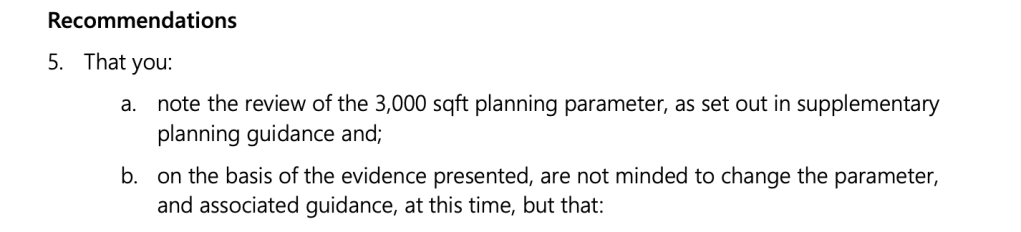
Instead, the minister rejected the recommendation and threw out the SPG. It’s important to say that the minister is entitled to reject an officer recommendation. The problem here is the complete absence of any public involvement in the decision making process. When the SPG was brought in, it was subject to public consultation. And there was “overwhelming” support for the SPG. So why no consultation this time around? It’s hard to avoid the conclusion that the minister was frightened that consultation would reveal the principle at stake – favouring family homes over mega homes for the very wealthy – would still be very popular. Crucially, a consultation would have shown that views other than those of the high net worth community were also being considered in the decision making process. It might have led to a compromise – for example, to increase the 3000 square foot limit, rather than abolishing it completely.
The minister said in the States says he is getting rid of the SPG because he wanted to support the construction industry and linked the decision to his pro growth agenda. But this is where the growth agenda becomes problematic, because in this case a growth agenda is being used as a smokescreen to favour the interests of the super wealthy against the interests of the community as a whole. Why? Because the SPG wasn’t anti construction or anti growth. It was biased against one type of construction (building mega homes) in favour of another type of construction (building family homes). It was still pro-growth, just a different kind of more sustainable growth.
When questioned about why he had changed the policy at the behest of three high net worth individuals, the minister replied that he hadn’t been contacted by any high net worth individuals. This was disingenuous. The high net worth individuals had contacted the Head of High Value Residency Engagement… who had contacted the minister. The point is, the minister was fully aware that three people had contacted the government to express unhappiness with the SPG, despite his reluctance to admit it in the States.
Conclusion
The policy doesn’t just affect high net worths. It affects all of us. The aim of the SPG was to increase the supply of family homes. Getting rid of the SPG reduces that bias in the planning system. From the point of view of the high net worth community and the minister, that is the whole point. The problem is, as an island we risk ending up with more mega mansions that we don’t need and fewer family homes that we do need.
I am not against the very rich. I know that many of them make a tremendous contribution to the island. They are entitled to lobby government. But a minister should consider – and be seen to consider – all points of view. It simply beggars belief that in this case the minister appears to have caved in to pressure from a small number of high net worth individuals without even holding a public consultation. It reinforces the notion that the super rich get to play by different rules to the rest of us.
http://www.gov.je/md/MDAttachments/Environment/Decisions in 2025/MD-ENV-2025-94 WR – (for DS) Review of 3,000 sq ft parameter.pdf
http://www.gov.je/md/MDAttachments/Environment/Decisions in 2025/MD-ENV-2025-94 R – MENV Review of 3,000 sq ft parameter.pdf

 Jonathan Renouf campaign