

I want to tackle recent commentary regarding the island’s response to climate change, because there have been a number of assertions that need challenging, particularly arising from various columns and letters in the JEP, but also in social media posts.
Points that have been made include:
- Climate change is either not happening, or if it is happening it is not because of human activity.
- There is no point in Jersey taking action to reduce our carbon emissions because our contribution to global emissions is insignificant.
- We’re failing to meet our emission reduction targets with the implication that we should therefore reduce or abandon our targets.
In this blog post, I will deal with the first of these points. Later posts will deal with the other subjects.
“Climate change is a hoax”
It is depressing to still be dealing with climate change denialism in 2024. So let’s be clear what climate scientists know for sure: the fundamental physics that lead us to conclude that putting more carbon into the atmosphere will warm our climate has been know for 150 years. The consensus that climate change is happening and that it is caused by humans has been overwhelming for 30 years or more, and gets stronger every year. Various utterly spurious arguments are still put forward to try and undermine the science, but they are all wearily familiar and have been convincingly rebutted over and over again.
Anyone interested in pursuing the science further can visit carbonbrief.org, which is a globally respected and independent source of information on climate change. This recent article deals with the scientific consensus on climate change and what that consensus means. Nasa have a good summary of the evidence along with a vast range of supporting material on their website, and there is also of course the IPCC, whose latest synthesis report is here.
This scientific consensus is not a plot. Scientists are not deliberately ignoring counter evidence. There has been no suppression of data. Even the oil companies and major oil producing nations sign up to the basic tenets of climate science and are also signed up (in principle at least) to the need to reduce carbon emissions. See this, this and this. In the case of the oil majors, they’ve known about climate change for decades and now face multiple law suits for suppressing the evidence.
We can say with complete confidence that three basic points are almost universally accepted, namely that the climate is warming, human emissions of greenhouse gases are the primary cause and the effects will be overwhelmingly negative for human civilisation (not to speak of the natural world).
It is worth remembering that the strategy of climate change deniers does not depend on convincing the public that climate change is not happening. They just aim to create doubt in the public mind, because if there is doubt, then it can be argued that we should stop taking action or at least delay, until doubt has been removed. In 2008 I made a BBC2 series called Climate Wars that told the history of the climate change debate. In episode 3 we reported on a memo that was written for the Republican Party in the USA, showing how to use the strategy of creating doubt to undermine the case for action. Here’s a clip.
Nothing much has changed since, except that our scientific understanding of climate change has become even more solid. The solidity of that science is why we build our preparations for the future – sea level defences, water resources, flood prevention, storm preparation etc – on the basis of scientific information, not climate change denialism. It would be grossly derelict for government to ignore the enormous weight of scientific knowledge and decide – for example – not to increase sea defences, just because a few whacky websites argue that we don’t need to.

Here are some of the myths that are put out in an attempt to sow confusion and weaken the case for action.
Myth 1: Carbon dioxide is essential for plant growth, therefore rising CO2 levels in the atmosphere are a benefit
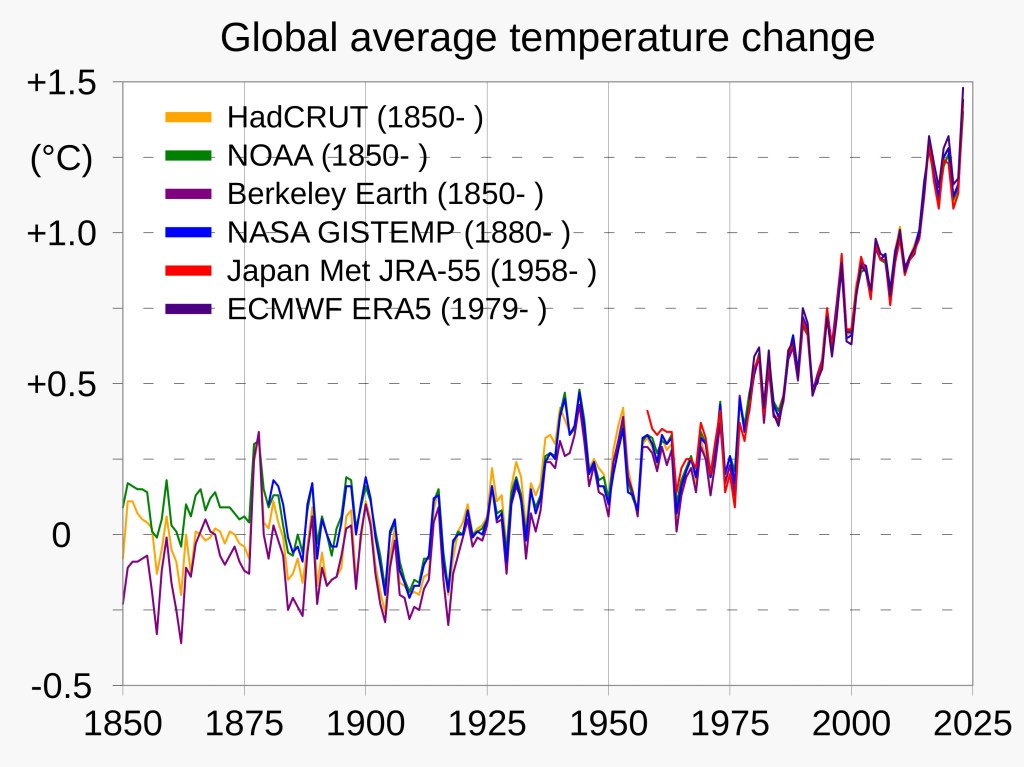
A classic case of taking a non controversial assertion (CO2 is vital for photosynthesis) and drawing an unrelated and unwarranted conclusion. The problem with carbon dioxide and other carbon molecules like methane is that they trap heat in the atmosphere, driving climate change (see graph above). Human civilisation evolved during a period of relatively climate stability (the Holocene). Our food systems, our water supply, our transport networks – they all developed in this stable climate. Destabilising the climate destabilises the basis of our civilisation.
On top of that, increasing carbon dioxide in the atmosphere leads to the acidification of the ocean. And a warming climate leads to melting icecaps and rising sea level, affecting millions of people living in coastal cities. In other words, the net effect of rising levels of carbon in the atmosphere are overwhelmingly negative.
Myth 2: Human emissions of CO2 are only a small part of the natural carbon cycle, and the natural cycles of nature remove carbon from the atmosphere anyway
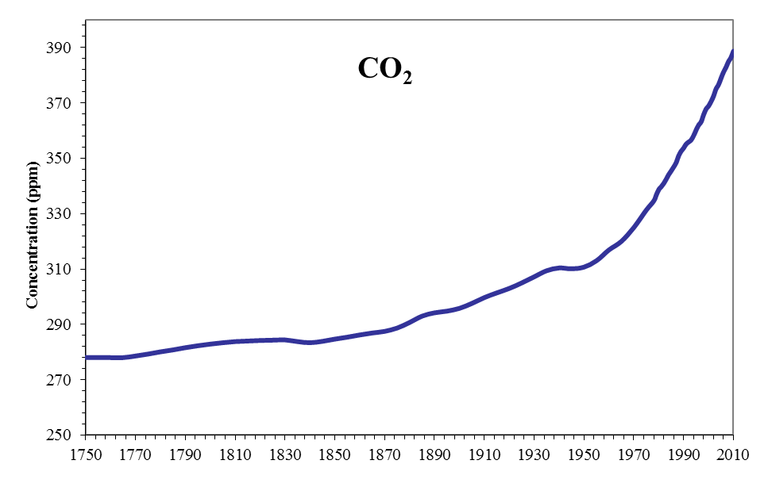
This is such tendentious nonsense it is hard to take seriously. The point about the natural carbon cycle is that until humans came along, it was essentially in balance. Carbon dioxide produced by natural processes was balanced by removal by natural processes. We are now massively overloading that natural carbon cycle, and since the processes that remove carbon are geological in time scale, they take thousands or even millions of years to operate. Net result? Massive increase in CO2 in the atmosphere.
Myth 3: The earth’s climate has always been subject to natural variation, therefore what’s happening now is just part of a normal climate cycle.
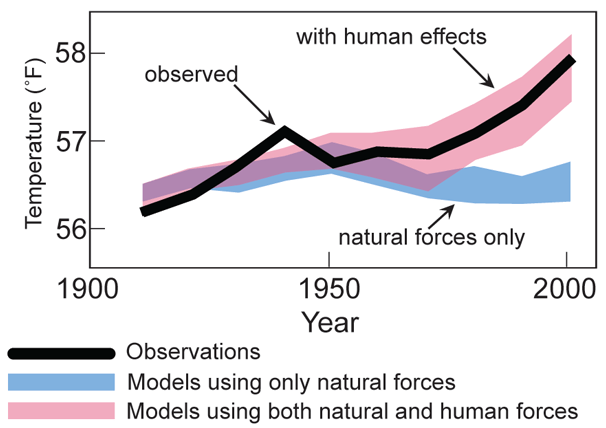
Another pairing of an uncontroversial statement (earth’s climate varies naturally) with a false conclusion. Earth’s climate responds to what are known as “drivers”; factors that shift the climate in different directions. One driver is changes in solar radiation received by the earth, which varies according to well known cycles. Greenhouse gases are another climate driver. The earth doesn’t notice whether these gases come from natural sources or human sources; the planet is just a climate machine, responding to basic physics. Today, we are increasing greenhouse gas concentrations at a phenomenal rate. The climate system will respond, just as it would if there was a sudden increase in CO2 from volcanic eruptions.
None of the natural factors driving climate can explain the increase in global temperatures over the last 100 years. It’s only when you put human factors into the calculations that you can explain the current temperature trends. This graph makes the point.
Conclusion
Over almost 30 years of my career making television programmes, many of them about climate change, I spent hundreds of hours looking at all the various sceptic arguments. None of them stood up. It is curious to me that there are people out there with no expertise in climate science who believe that they know better than the experts. I would no more take the “advice” of armchair experts on climate than I would on brain surgery or nuclear physics.
Sometimes I’m told that this shows I have a closed mind. No, I don’t. As I say, I’ve looked at all the “sceptic” arguments, some of them many times over, and in far more detail than most of those accusing me of having a closed mind. The sceptic arguments all fail, every time. Should new evidence emerge that challenges the basic story, I will be all over it. But that evidence won’t be found on fringe websites, or tiny pressure groups. If the science ever is seriously challenged, it will be front page news all over the world.
There is a serious argument to be had about the how we should tackle climate change, the costs versus the benefits, the best ways to reduce our emissions and so on. For me, there is a huge opportunity for Jersey in pursuing a net zero strategy. Others may disagree. That is a debate worth having. But let us put behind us the pretence that there is still any doubt about the existence of human induced climate change.

 Jonathan Renouf campaign